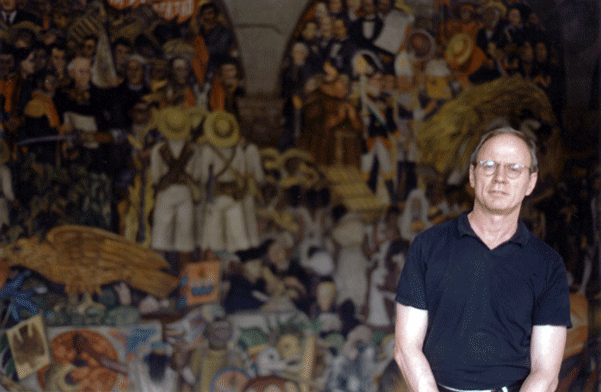
Photograph Copyright © 2001 by Miguel Cervantes-Cervantes.
|
This website protected by U.S. and international copyright conventions and laws.
Copyright © 1998, 2014 Norman MacAfee |
|
Photograph Copyright © 2001 by Miguel Cervantes-Cervantes.
|
This website protected by U.S. and international copyright conventions and laws.
Copyright © 1998, 2014 Norman MacAfee |
| Links
Other Links To buy One Class: Selected Poems, 1965-2008 |
Norman MacAfee is a writer, visual artist, literary translator, and freelance book editor. He lives in Greenwich Village with Miguel Cervantes Cervantes, a plant biochemist. To read an interview about Norman MacAfee published in August 2006 click here. Norman MacAfee's books of poetry include One Class: Selected Poems, 1965-2008, A New Requiem and The Coming of Fascism to America. Bob Holman says of One Class, “Like history where dates are midnight assignations, like sexual encounters that bristle with political implications, One Class presents a unified social theory of life and art, love and politics and aesthetics, that is fearless and human. When Salman Rushdie forked over his 5 bucks to buy MacAfee’s chapbook The Coming of Fascism to America at the Bowery Poetry Club, I saw in his face the same look I get when I read this work “it’s real, it’s unwavering, it’s art in the classical sense that gets dirty as life is in this Horrific Triumph of Capitalism. Somehow MacAfee tells the truth and doesn’t leave you hopeless. Somehow MacAfee gets it right.” Jack Hirschman writes of One Class, “How good it is to read a poet with some political consciousness who doesn’t throw it in the pot of experimental egoism, so that the reader actually comes away from One Class with a sense that he or she is part of a living process that is momentous. Whether or not one agrees with what Norman MacAfee means by the title, no one will be able to deny that these poems are forms of political excitement, even incitement, and that like the Italian master, Pier Paolo Pasolini, whose work he has has so brilliantly translated, MacAfee manifests the three elements, “Passion, Provocation and Prophecy,” that are the measure of all great books of poetry.” In his book The Gospel According to RFK: Why It Matters Now, Norman MacAfee outlines a vision for America inspired by the 1968 presidential campaign of Robert F. Kennedy. You may buy the book from Amazon. Norman MacAfee’s opera, The Death of the Forest, set to music he has chosen by Charles Ives, tells the story of King Philip’s War, fought between the Native peoples and the settlers in New England in 1675-76. The executive artistic director of the Massachusetts International Festival of the Arts/MIFA, Donald T. Sanders, has written, “I think that The Death of the Forest can become an American cultural treasure produced by opera companies the world over.” Click here to see a drawing by Norman MacAfee for the cover of the libretto of The Death of the Forest. MacAfee’s translation (with Lee Fahnestock) of Victor Hugo’s Les Misérables is the only complete modern edition in English. Since its publication by Signet in 1987, it has sold more than a million copies. The MacAfee-Fahnestock translation is the official tie-in edition for what has been called “the world’s most popular musical.” To buy Les Misérables from Amazon, click here. Norman MacAfee has translated (with Luciano Martinengo) the only edition of the major poems of the Italian filmmaker and poet Pier Paolo Pasolini (1922-1975). Though better known as a master filmmaker, Pasolini was an important writer, called by the American Book Review one of the three great poets of the twentieth century. Pier Paolo Pasolini: Poems is published by Farrar, Straus & Giroux. See reviews for Pasolini: Poems and buy the book. Jean-Paul Sartre (1905-1980) and Simone de Beauvoir (1908-1986) are two of the twentieth century’s greatest writers. Norman MacAfee and Lee Fahnestock have translated the only English edition of Sartre’s letters, edited by Simone de Beauvoir, in two volumes, Witness to My Life and Quiet Moments in a War, published by Scribner in New York and Penguin in England. Click on the titles if you wish to buy the book. MacAfee’s screenplay, Life Begins Tomorrow, is based on events in the letters. In 2008, Arianna Huffington asked Norman MacAfee to write for The Huffington Post. Dozens of posts have resulted; for example, “The Presidency of Al Gore, 2001-2009,” published there in May 2008, imagines what the world would be like if Gore, not Bush, had become president in 2001. MacAfee’s poems and other writings have appeared in over 30 magazines. Click here for a list of his publications. |
Norman MacAfee’s E-mail address is: nsmacafee@earthlink.net